
Feeling short of time or finding it difficult to concentrate? You can listen to this post.

Hello! I’m Gayle Swift and today I am reading the Growing Intentional Families Together blog dated, Sept. 2, 2020 and titled Parents Need to Handle Their Own Tough Stuff
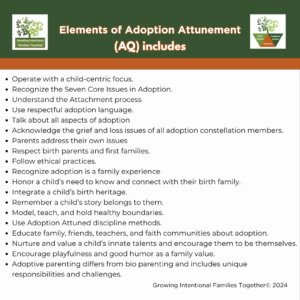
Families follow a core set of values that governs their priorities, shapes their belief system, and guides their behaviors. Growing Intentional Families Together also has a guiding set of principles and beliefs that inform our coaching and writing: specifically, our Adoption Philosophy and the Elements of Adoption Attunement. These two pillars serve as the lenses through which we explore adoption-related topics as well as our blogs, podcasts, webinars, coaching and coach training.
Today let’s focuses on a specific Adoption Attunement Element: Parents handle their own stuff.
Growing intentional Families Together believes that parents must address their own issues. It’s important to keep in mind that adoption is both a personal experience and a communal or family experience. What affects one, impacts all. Understanding this Tri-Relational Interconnectivity helps sustain a TriSpective viewpoint of their family life together.
So, what might these issues be? And whose issues are we talking about? Parents. Adoptive and birth parents. Becoming a parent through adoption or losing a child to adoption evokes strong emotional responses within adoptive and birth parents. They do well to explore, understand, accept, and come to terms with this reality. The bigger question is, why does it matter?
When not addressed, emotional repercussions reverberate through their relationships with others—especially their children. These buried and unresolved feelings eventually erupt often with damaging ferocity. Parents can feel overwhelmed or challenged by the emotions, grief, and losses connected with infertility, adoption complexity or child relinquishment. They don’t want to burden their children with the weight of these unresolved issues or the long shadows they cast.
What stuff might this be? Let’s consider infertility first. Most, but not all, adoptive parents choose adoption because of infertility issues that render pregnancy impossible. Once hopeful parents accept that pregnancy is impossible, most quickly shift their goal from getting pregnant to adopting. However, adoption is not a magic wand. It does not erase the emotional, physiological and psychological effects of infertility that adoptive parents experienced. Nor does it ease the agony birth parents feel over relinquishing a child. In fact, birth parents often see adoption as the cause of their pain.
 In his book, The Body Keeps the Score Bessel van der Kolk M.D. asserts that trauma imprints on the body even when the trauma remains beyond conscious awareness. For example, parents who experienced infertility recall the emotions fueled by monthly cycles of hope followed by crushing despair. Birth parents always remember the moment their child was removed from their lives. The echoes of pain, sadness, and resentment of both infertility and relinquishment create imprints that are both significant and permanent. Birth and adoptive parents need and deserve the time and attention to process, manage, and heal these issues.
Acknowledge, explore and process
Without doubt, these upheavals evoke an emotional response within birth and adoptive parents. They do well to explore, understand, accept, and come to terms with this reality. If not addressed, emotional repercussions will reverberate through their relationships with their children. Buried and unacknowledged feelings will eventually erupt usually with damaging ferocity and at the worst times.
This is not a relationship strategy that adoptive parents want to model for their children. Instead, they want to show their children that it is important to face issues they find challenging. Adoptive parents must show they are capable of managing their own feelings. And, make it clear that it is not the child’s responsibility to hide or minimize their adoption-connected thoughts questions, struggles and feelings in order to shelter parental hearts from sadness.
When kids focus on caretaking parental emotions, most will stuff, deny, or minimize their own. Instead of relying on adoptive parents as a sounding board to explore their own complex feelings and as a source of comfort and security, most children will struggle to handle them alone and without the experience, skillsets, and perspectives that adults have. Children’s ability to manage complex grief and loss is not yet strong enough. They need their parents to provide that safe harbor. Children need to be able to believe that parents are capable of hearing difficult stuff without falling apart emotionally themselves.
Being an example
All parents strive to be good role models for their children. For example, they strive to show their children that they are capable of managing the family through times stormy and calm. Adoptive parents committed to some additional responsibilities when they adopted. One is to show their children, they can manage their own feelings without falling apart when the family engages in Difficult Conversations. Attuned adoptive parents can calmly discuss the hard truths of adoption. They can provide comfort, security, and a safe space where children can express hard truths. This security helps build trust. This reassures the children that their family bond will survive uncomfortable conversations and challenging dynamics.
It tells them they can share their adoption-connected thoughts, feelings, and questions without feeling any obligation to protect their parents from sadness or discomfort. This Attuned intentionality is important because in the absence of this secure base, kids will focus on caretaking their parents. This will lead adoptees to stuff, deny, or minimize their own feelings and needs alone, without adequate experience, skillsets, and perspectives. Without the comfort of the parents who love them. Nobody wants that.
If parents feel overwhelmed or challenged by the emotions, grief, and loss connected with infertility, adoption complexity, or child relinquishment, they must not burden their children with the weight of these feelings or the shadows they cast. Parents must attune to their own needs with the same intentionality that they strive to attune to their children’s needs. They must find a qualified Adoption Attuned professional to help them cope and to ensure that they have handled their stuff. By the way, this is an ongoing process—not a once-and-done thing. This will help prepare parents to be fully available to their children to support them as they handle theirs. The entire family will be healthier, happier, and more authentic in their relationships with each other.
Finances
Infertility and adoption are both inextricably entangled with finances. Adoptive parents must be careful not to overextend their financial stability as they pursue the dream of conception and/or adoption. They must remain true to the highest ethical standards when they engage in family-building strategies. They cannot allow their hunger to be parents to blind them to the ethics and morality of whatever paths they follow. (Our previous blog explored some of the tragic fallout of ethical and/or legal lapses.)
Our children depend on us to keep them safe. Living aligned with our ethics is important both as a model for them to follow and for the security and stability that doing right creates. How are you ensuring that you are handling your “stuff”?
(Here is the entire list of the Elements of Adoption Attunement (AQ). Feel free to copy and share.
__________________________
- Call us at 1-800-653-9445
- Listen to our podcasts: Adoption Matters: Real People. Real Life. Real Talk and Essentials of Adoption Attuned Parenting
- Watch our YouTube channel
- Read Books written by our coaches
-
Click to learn more about Adoption Attuned Certified coaching!
revised 06.06.2026